Broad spectrum of real estate (Training Model)
Real estate is a legal term that includes land as well as improvements made to it, such as buildings, infrastructure, and other improvements, located in a specific location and constituting immovable property that can be purchased, leased, sold, or transferred together or separately. Real estate is one of the primary (and indeed the only) assets whose value does not decrease over time.
Real estate is a broad term that encompasses:
Residential new homes and existing (resale) homes.
Commercial shopping centers and offices.
Industrial and institutional buildings.
Vacant land and farmland.
➤ The profession or work of an agent in the purchase and sale of real estate.
It is an attractive form of collateral because it cannot be stolen or destroyed.
Indian Real Estate Industry
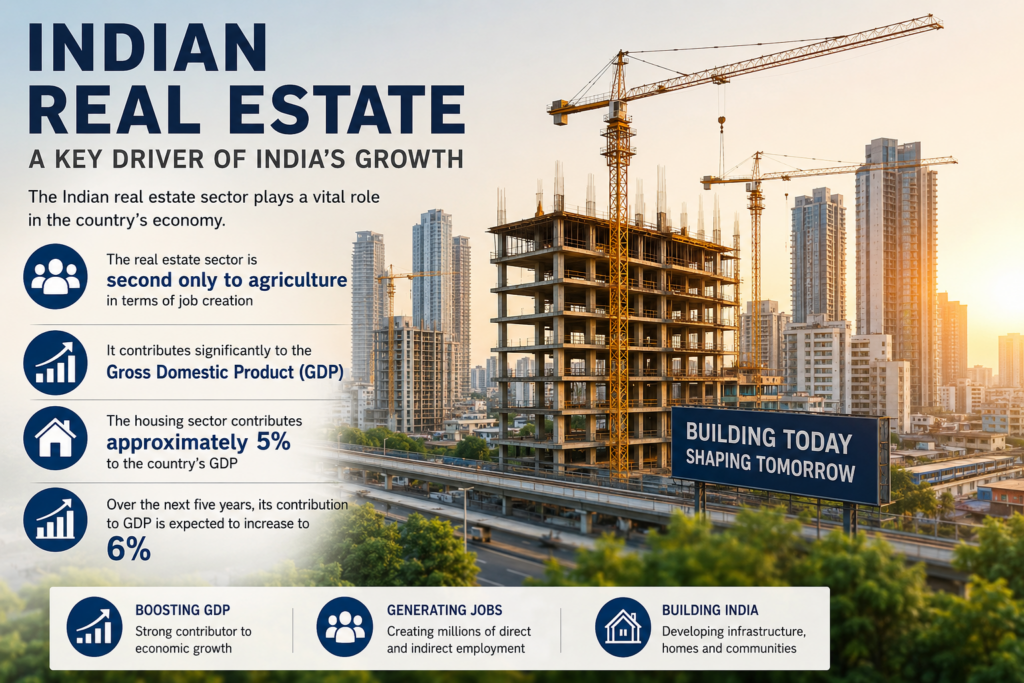
The Indian real estate sector plays a vital role in the country’s economy. The real estate sector is second only to agriculture in terms of job creation and contributes significantly to the gross domestic product (GDP). The housing sector contributes approximately five percent to the country’s GDP. Over the next five years, its contribution to GDP is expected to increase to 6 percent.
Approximately 80 percent of developed real estate in India is residential, with the remainder comprising offices, shopping malls, hotels, and hospitals.
Approximately 80 percent of developed real estate in India is residential, with the remainder comprising offices, shopping malls, hotels, and hospitals.
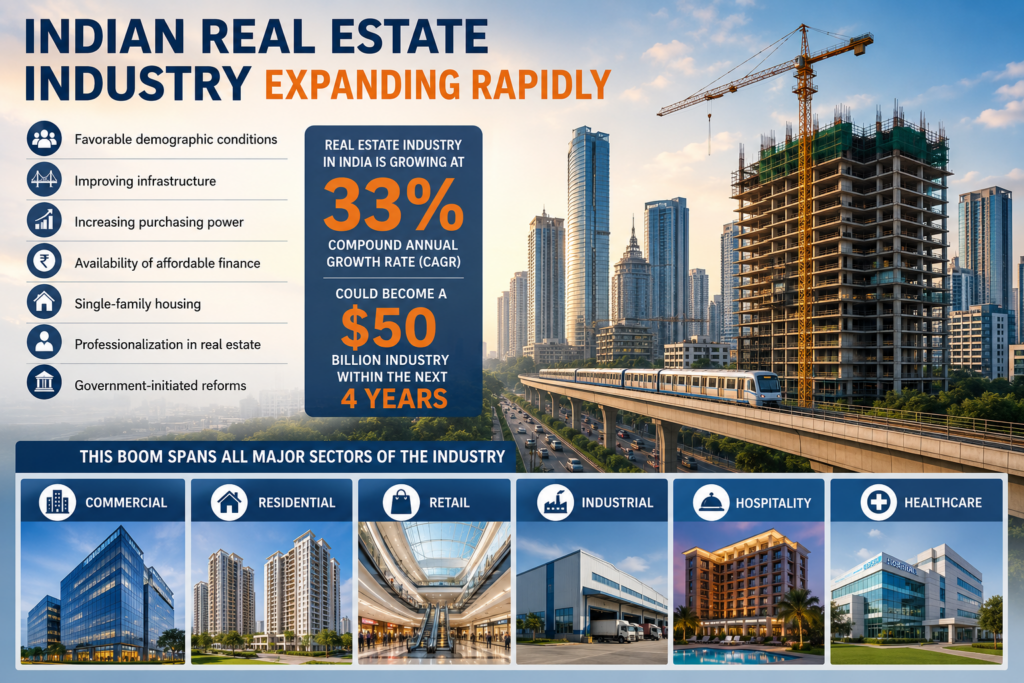
The Indian real estate industry is expanding rapidly. Favorable demographic conditions, improving infrastructure, increasing purchasing power, the availability of affordable finance, single-family housing, professionalization in real estate, and government-initiated reforms are some of the key factors driving this impressive growth. According to industry estimates, the real estate industry in India is growing at a 33 percent compound annual growth rate (CAGR) and could become a $50 billion industry within the next four years. This boom spans all major sectors of the industry, including commercial, residential, retail, industrial, hospitality, and healthcare.
About Property
Real estate is often considered synonymous with property. Property generally refers to a piece of land; Property is any tangible or intangible asset that is owned by a person. Property can be owned by individuals, companies, housing associations, or local authorities. Property can be freehold or leasehold.
Freehold Property:
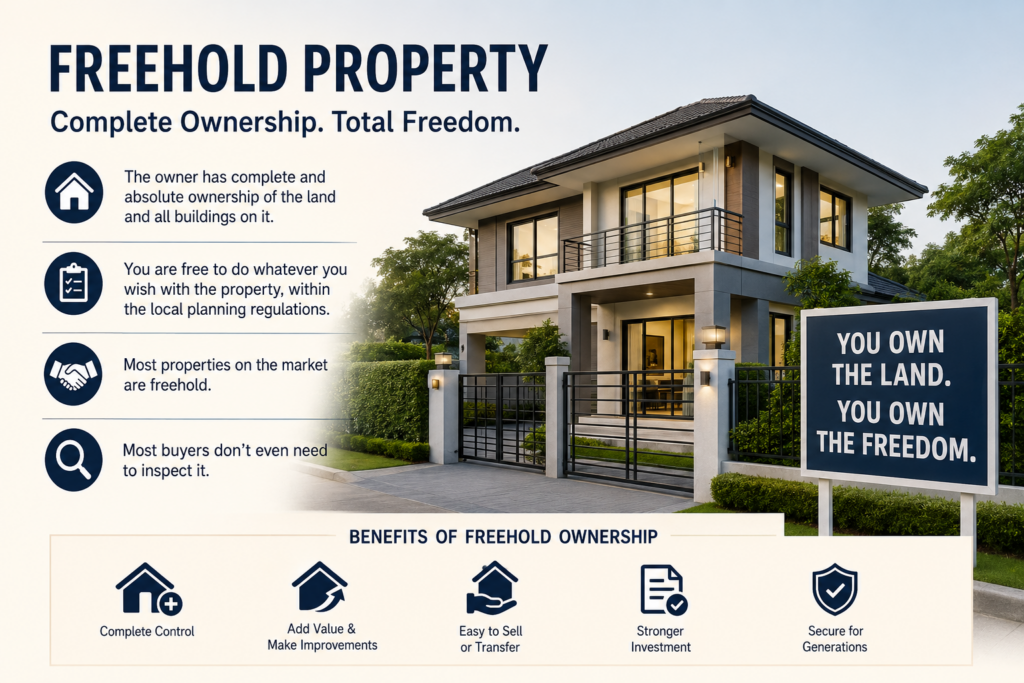
This refers to property where the owner has complete and absolute ownership of the land and all buildings on it. Therefore, the owner of a freehold property is able to do whatever they wish with the property, within the local planning regulations. Most properties on the market are freehold, and most buyers don’t even need to inspect it.
Leasehold Property: This refers to long-term tenancy—the right to own, occupy, and use the property
for a long period, called the “term” of the lease. This can range from 99 to 999 years; and the property can be bought and sold during this period. There are “long” leases and “short” leases, reflecting the number of years remaining on the lease.
Lal Dora Property: The term “Lal Dora” was first used in 1908. It is a
classification of land in a village that is part of the village’s “abadi” (settlement). It was to be used only for non-agricultural purposes. This portion of land was considered an extension of the village settlement, where villagers’ livelihoods, livestock, etc. were located. The Lal Dora was exempt from building bylaws and strict construction norms and regulations. There was/is no need to enforce it.
In India, all properties are freehold properties; however, properties in Noida and Greater Noida (National Capital Region) are leasehold properties with the relevant authorities.
Although properties in Noida and Greater Noida are leasehold properties, this does not affect the individual’s ownership rights. The property owner retains full rights to the property, and a sublease deed is registered with the relevant authorities.
It is believed that in the future, the Noida and Greater Noida authorities will introduce some provisions to convert all properties to freehold, charging a nominal fee.
Types of Property
Property can be broadly divided into two types:
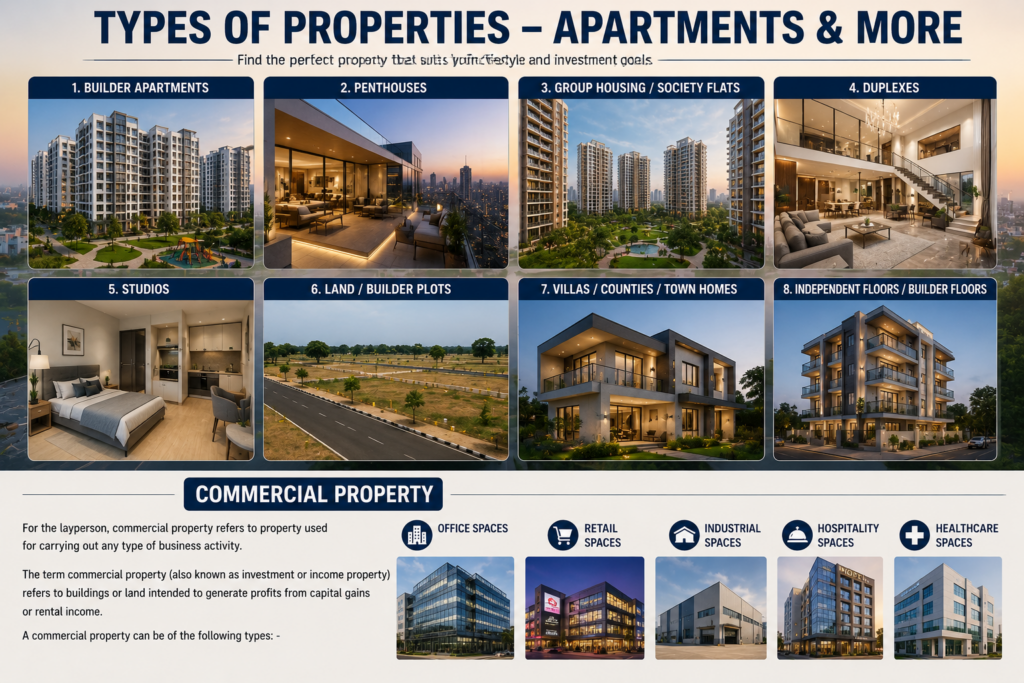
Residential Property: For the layperson, residential property refers to a residential unit used solely for residential purposes and not for any commercial purposes. Residential property can be of the following types:
➤ Apartments
Builder Apartments
. Penthouses
. Group Housing/Society Flats
. Duplexes
. Studios
. Land/Builder Plots
. Villas/Counties/Town Homes
. Independent Floors/Builder Floors
Commercial Property: For the layperson, commercial property refers to property used
for carrying out any type of business activity. The term commercial property (also known as investment or income property) refers to buildings or land intended to generate profits from capital gains or rental income. A commercial property can be of the following types: –
➤Industrial
Manufacturing Industry
Service Industry
➤Institutional
Hospital
Educational Institutionabout:blank
Community Center
Club
➤Commercial
Local Retail Market
Mall
Hotel
Office Space/Business Park
Shop-cum-Office (SCO)
SEZ
Single Product
Multi-Product
IT SEZ
Export SEZ
Any Specialized SEZ
Type of Property Transaction
1. Primary Sale: Also known as fresh booking or original booking, this refers to the sale of a property for the first time. The entity purchasing the property is the first owner of the property.
Direct allotment of property through various government schemes.
Purchasing property directly from the builder.
If you are purchasing a property directly from a builder like DLF, Unitech, Emaar MGF, etc., you are involved in a primary sale transaction.
There are two parties involved: the builder/local authority and the person purchasing the property. In the case of a primary sale, the real estate agent involved in the transaction charges their service fee only from the builder, not the buyer. This way, you can tell clients that they charge zero brokerage.
2. Secondary Sale: Also known as “resale,” this refers to the second sale of a property. The two parties involved are the first owner of the property and the buyer, or in other words, you do not become the first owner of the property.
There are two parties involved: the original owner of the property and the buyer. In the case of a secondary sale, the real estate agent charges a service fee from both the original owner and the buyer.
3. Corporate Leasing: This refers to assisting various business houses or institutions in finding leased/rented premises for their business activities.
4. Residential Leasing: This refers to assisting various individuals and companies in finding leased/rented premises for their residential use.

Measurement Parameters
Property is generally measured in the following units:
➤ Square Feet (Sq. Ft.)/
➤ Square Meters (Sq. Mt.)
➤ Square Yard (Sq. Yd.)
Acre – called Qila in Hindi
➤ Hectare
➤ Marla
➤ Channel
In North India, land is generally measured in square yards or square meters, and apartments/flats are generally measured in square feet.
Conversion:
1 square meter = 10.76 square feet / 1 acre = 4046.85 square meters
1 square yard = 9 square feet /1 marla = 30 square yards
1 square meter = 1.196 square yards /20 marlas = 1 kanal
1 square yard = 0.83 square meters /1 kanal = 600 square yards
1 acre = 4840 square yards /8 kanal = 1 acre
1 acre = 43560 square feet /1 hectare = 2.4711 acres
Types of Area:
Carpet Area: The actual area you use. The area you can carpet, the wall-to-wall area of the interior. Carpet area is typically around 70-75% of the super built-up area.
Built-up Area: This area is in addition to the carpet area and includes the space covered by the thickness of the interior and exterior walls of the flat. This area is typically around 10% more than the carpet area.
Super Built-Up Area: Super Built-Up Area refers to the covered area of the leased premises.
The area below the perimeter walls, the area below the columns and walls within the leased premises, half of the wall area along with other premises adjacent to the leased premises, the total area of cabinets, plumbing/electrical shafts, balconies, and terraces of the leased premises, and a proportionate share of common areas such as common lobbies, elevators, common service shafts, staircases, machine rooms, mammi, power substations and other services, and other common areas. In North India, properties are sold based on the super built-up area, and the buyer pays based on the size of the super built-up area.
Various Terms Used in Primary Sales
Group Housing Project: This refers to a project being developed by a builder whose objective is to provide group housing. In some areas, local authorities have set a minimum land limit for a group housing project. In group housing, the builder cannot sell independent floors or plots.
Cooperative Group Housing Societies: This refers to a group housing project developed by a cooperative group housing society.
For example, BHEL Society, Rail Vihar, Jal Vayu Vihar, etc., provide company housing for its employees at affordable rates.
A cooperative group housing society can also be developed by a group of people who have registered a society and have a common interest in building a group housing project for their residential use rather than commercial use.
Township: This refers to the development of a large land area exceeding 100 acres, including plots, villas, group housing, flats, etc. This area also includes schools, hospitals, and commercial spaces. Local authorities in a particular area have set a minimum land limit required for developing a township. All infrastructure in the township, such as roads, sewage pipes, drainage, and electricity poles, has to be developed by the builder.
Pre-launch sales: Also known as soft launch, this refers to the sale of a project without 100% approval.
To obtain the necessary approvals for project development, many builders have recently been promoting pre-launch sales of their projects, offering pricing benefits to buyers willing to purchase the project without 100% approval. Once the project launches, prices are either raised or apartments in good locations are already sold.
Launch sales: This refers to the sale of a project that has received 100% approval. Typically, in North India, project sales begin only during the pre-launch phase.
Opening discounts: Many builders offer opening discounts during the pre-launch phase to entice buyers to purchase the property. They also use this technique to generate excitement and increase prices to boost sales.
FAR and FSI: – FAR stands for Floor Area Ratio and is used for commercial properties, FSI stands for Floor Service Index and is used for residential properties.
Both refer to the total area that can be built on a particular piece of land, for example.Suppose if the FSI of a property is 1.75(x) and the total land area is 10 acres, then the total area that can be built in square feet is: –
10 acres ÷ 43560 square feet = 435600 square feet (converted to square feet)
1.75(FSI) * 435600 = 762300 square feet (multiply the FSI of the plot by the total square feet area of the plot)
Thus, the total buildable area is 762300 square feet. The higher the FSI, the lower the property price because more houses can be built on the same land and so on, the lower the FSI.
Recently, the government has increased the FSI for existing land as well as old land, which has helped provide housing to more people and promote affordable housing.
Land coverage: This refers to the maximum land that can be covered for construction. The smaller the plot size, the larger the land coverage area. The larger the plot size, the smaller the land coverage area.
Relating this to the FSI example, suppose if the maximum land coverage allowed for a plot is 40%, then the land that can be covered is:
40% (10 acres X 43560 sq ft) = 174240 sq ft.
Now, to cover the total area available for construction, the builder will have to spread the construction over 4.5 floors (7,62,300/174240), with each floor measuring 174240 sq ft.
The government has set a maximum land coverage limit, but you must use a land coverage less than the maximum permitted limit. For example, if the maximum permitted limit is 40%, but you only want 20% coverage, the calculation would be as follows:
20% (10 acres x 43560 sq ft) = 87120 sq ft.
Now, to cover the total area available for construction, the builder would have to spread the construction over 9 floors (762300/87120), with each floor having an area of 87120 sq ft.
However, the government has set certain limits on building height, so appropriate permutations and combinations must be made to ensure the correct combination of land coverage and FSI.about:blank
Density: – Represents the population permitted per acre of land. In Gurgaon, the current permitted density is approximately 250 people per acre (PPA), while in Noida and Greater Noida, the current permitted density is approximately 600 people per acre (PPA). In Gurgaon, the average size of an entire apartment in a complex must be approximately 1,900 square feet, while in Noida, the average size is approximately 1,200 square feet.
Atrium: A central area illuminated by skylights, often containing plants, in some modern buildings, especially public buildings and commercial properties.
Podium: A podium is a platform used to raise something slightly above its surroundings, for example, an orchestra conductor standing on a podium.
Mezzanine floor: An intermediate floor between two floors above the ground floor, accessible only from the lower floor.
Floor plan: This describes how the apartment will look and the size of the unit/apartment. It shows the layout of the various rooms, their sizes, and connectivity. A particular floor plan also indicates which apartment sizes are available in which block of the building.
Cluster plan: Also known as the tower layout, this is the layout of the entire building; it shows the layout of all apartments on a floor, the number of apartments per floor, the location of staircases, lobbies, elevators, etc. It also helps analyze the distance between apartments and the merging of various sizes.
Site plan: The layout of all buildings located in the complex. It helps analyze:
➤ The direction of apartments and green areas in the project. The site plan indicates north, south, east, and west directions. You can easily locate the direction of a unit/apartment through the site plan. The sun rises in the east and sets in the west, while the sun moves from east to west, orbiting the south. For some, the direction criterion relates to the direction of the main entrance of the unit/apartment. However, in most cases, the direction criterion relates to the direction of the facade of the unit/apartment.
➤ Combinations of different sizes in towers, sometimes different sizes are marked in different colors or different sizes are mentioned for different blocks at the top of the block.
The number of units/apartments on the floor and their numbering scheme.
Location of the clubhouse and other amenities in the complex.
➤ Distance between two buildings and the feasibility of connecting two apartments together.
Location of parking, parks, children’s play areas, etc.
Entrances and exits to the entire complex.
Gated community: In its modern form, a gated community is a type of residential community or housing estate; it has strictly controlled entrances for pedestrians, bicycles, and automobiles, and is often marked by a closed perimeter of walls and fences.
Building height: This refers to the number of floors a building can have. It’s usually written as G+7, meaning the ground floor plus seven additional floors. Sometimes it’s also written as S+10, meaning the building doesn’t have a ground floor, has parking on the ground floor called a stilt (S), and has 10 additional floors.
Escalation charges: When a builder sets a property price, they factor in price increases.
Economic inflation, which can affect their costs because project construction is spread over a period of 2-3 years. Economic changes can cause builders to experience significant increases in costs, leading to higher labor and raw material costs. Builders typically exempt prices from escalation charges. Sometimes, these charges are escalation charges.
If inflation rises beyond a set limit, the builder increases property rates accordingly.
Earnest Money Deposit: The booking amount paid with the booking application. It is typically around 10% of the original sale price.
Capital Gains Tax: This tax is paid to the government on profits earned from the sale of a property.
A power of attorney is someone else’s signature on legal documents for a specific purpose. A power of attorney is valid only if it is registered. For non-resident Indians, a power of attorney can be registered at the local Indian Embassy.
Property can also be sold using a power of attorney instead of registering it. Many cooperative group housing societies and builder floors do not allow registration. In such cases, the property is sold using a power of attorney. There may also be situations where registration is suspended for a certain period, and even in such cases, the property is sold using a power of attorney. Sometimes, some buyers obtain a power of attorney from the seller to avoid the registration fee, giving them full ownership of the property.
Purchasing a property using a power of attorney is not 100% secure, and if the property is purchased using a power of attorney, the buyer cannot avail of a home loan.
Payment receipts: These receipts are issued by the builder to the buyer, confirming the amount received in exchange for the booking amount.
Allotment Letter: This is a document issued by the builder to the property buyer, detailing the number of units or apartments being allotted to the buyer and how payments are to be made.
Builder Buyer Agreement: This is the most important document in case of primary booking.
An agreement that includes all the terms and conditions of the property purchase, the total price of the property, and the payment schedule. It is signed by both the buyer and the builder. The original copy is made in two copies; one with the builder and the other with the buyer.
EWS: This refers to Economically Weaker Sections. The government has mandated that homes in certain group housing projects and townships be sold exclusively to individuals belonging to economically weaker sections of society.
Property Tax: This is a tax paid to the government as per rules and regulations. Currently, property tax is not applicable in Noida, Greater Noida, Gurgaon, and Faridabad; it is applicable only in Delhi.
Documents Required for Conceiving a New Project and the Builder’s Process
The documents and procedures followed by a builder to launch a new project vary from city to city. Below is a description of the required documents and procedures:
Gurgaon and Faridabad
The Haryana government has outlined the land use and location of various sectors in Gurgaon in its 2021 Master Plan. Currently, most of the land in the developing sectors is used by villagers for agricultural purposes. Builders in Gurgaon follow the following process:
Identifying the land the builder wishes to purchase.
Ascertaining the legality of land ownership with the help of Patwaris and ensuring that the land is free of all encumbrances.
Once the builder is satisfied, they purchase the land from the villagers.
The builder then registers the land in their name.
Since the property is used for agriculture, the builder must obtain a CLU (Change in Land Use) according to the purpose of purchasing the property, i.e., residential/commercial. The CLU will be as per the master plan.
The builder then submits a LOI (Letter of Intent) to the relevant authority.
Once the authority grants the LOI, the builder is required to deposit the license fee along with EDC and IDC charges to the authority within the stipulated period.
Once all the money is deposited with the authority, the license is issued to the builder.
There are two types:
Short-Term Capital Gains Tax: When a property is sold within three financial years of purchase, a 30% tax is levied on the profit earned.
Long-Term Capital Gains Tax: When a property is sold after three financial years of purchase, a 20% tax is levied on the profit earned.
The tax rate varies according to government policy. An entity can avoid this tax if it reinvests the proceeds from a transaction in a property within one financial year of the sale. Proceeds from the sale of a residential property cannot be invested in a commercial property. To safeguard funds, banks open special accounts for this purpose in which the proceeds from the sale of a property can be held. To avoid capital gains tax, some buyers take the proceeds of the transaction in cash, leading to black money transactions. Government policies regarding capital gains change from time to time, so it’s important to stay updated on them.
Power of Attorney (POA): A legal document that allows the transfer of rights to
➤ Building layout approval from the relevant authority.
➤ Building structure approval from the Geological Department.
➤ Floor plan approval from the relevant authority.
➤ Approval from the Fire Department.
➤ Approval from the Environmental Department.
➤ Approval from the Drainage and Electrical Departments.
Height approval from the Aviation Department.
➤ Approval from the Water Department.
Once the builder receives all approvals from the relevant authorities, they can begin construction. However, builders typically begin pre-launch property sales after receiving the LoI.
Noida and Greater Noida: The process for a builder to launch a new project in Noida and Greater Noida is relatively simple and quick. Below are details of the required documents and procedures:
➤ The relevant authority acquires land from villagers and takes possession of the land as per the master plan.
Tenders are issued in the market to purchase land from the authority.
Interested builders apply for the tender, and the builder who pays the highest amount gains ownership of the land.
The builder pays an advance amount for the property and receives an allotment letter.
The builder pays the remaining amount according to the agreed payment plan and registers the land in their name.
Building layout approval from the relevant authority.
Building structure approval from the Geological Department.
Floor plan approval from the relevant authority.
Fire department approval.
Environment department approval.
Drainage and electrical department approval.
Height approval from the Aviation Department.
Water department approval.
Once the builder receives all approvals from the relevant authorities, they can begin construction. However, pre-launch property sales begin after receiving the allotment letter.
Price list and components
Builders provide a price list detailing the total property cost and other charges. In modern times, builders advertise properties without including other fees to make the price appear attractive. The price list includes various factors:
Basic Selling Price: Also known as BSP, it refers to the cost of the property without any additional fees.
EDC and IDC: External Development Charges and Infrastructure Development Charges
These charges are primarily levied by the government for overall development of the area, such as roads, parks, drainage systems, sewage, electrical wiring, etc. They are collected by the property builder from buyers and deposited with the government. Builders charge EDC and IDC at current rates, although in the event of any further revisions to these charges by the government, the builder reserves the right to demand revised charges from buyers. EDC and IDC are charged in all projects in India except Noida and Greater Noida, although Jaypee’s projects in Noida and Greater Noida charge EDC and IDC. EDC and IDC are mandatory charges.
Lease Rent: Lease rent is charged only in Noida and Greater Noida. Since all properties are leasehold with the authority, these charges are collected by the builder from the buyer and deposited with the authority. Typically, lease rent is for a period of 99 years, and it is assumed that the authority will make provisions in the future and convert the leasehold property to a freehold property for a nominal fee. Lease rent is a mandatory fee.
PLC: Not all apartments in a complex are in premium locations; some are better than others. Therefore, the builder charges a preferred location charge (PLC) to differentiate between apartments in good and poor locations. PLC is not mandatory; PLC can be of several types:
Floor PLC: The builder charges an additional fee for apartments located on lower floors. This concept is prevalent in North India, while in the rest of India, PLC is charged for higher floors.
Landscape/Garden PLC
Corner PLC
Road Facing PLC
Club House Facing PLC
Pent House PLC
Top Floor PLC
Any Specific Unique PLC
Golf Course Facing PLC
Power Backup Charges: – These are mandatory charges. The builder provides two types of power backup:
100% Power Backup: This means you can use all your appliances in case of a power outage.
Specific Power Backup: This means the builder provides a connection with an upper limit of 2 kVA or 5 kVA, thereby limiting power usage.
In both cases, separate electricity meters are installed, and the buyer has to pay according to the actual electricity consumption. The charge is usually around Rs. 10 per unit. Typically, the builder provides 100% power backup for luxury apartments and specific power backup for affordable apartments.
EEC: – Electricity connection charges are levied for laying electrical wires and points. EEC is a mandatory fee.
FFC: Fire fighting charges are levied for the installation of fire fighting equipment. FFC is a mandatory fee.
Car parking charges: The builder charges separately for car parking, and there are various types.
Speaking of car parking charges, it is mandatory to purchase car parking in most projects. In luxury projects, the number of mandatory car parking spaces depends on the type of housing and the size of the apartment. Generally, in the case of villas or independent floors, the car parking fee is included in the price.
➤Covered car parking: This refers to car parking in the basement area.
Open car parking: This refers to car parking on the ground floor.
➤Stilt car parking: This is a type of covered car parking arrangement on the ground floor, as there are no apartments on the ground floor.
Back-to-back parking: Some locations also offer back-to-back parking.
Projects that have extended parking spaces, allowing two cars to park in one space, are cost-effective compared to purchasing two car parks, but they can also be a hassle if you need to move your car out of the rear parking space.
Club Fees: These are also called CMRCs (Club Membership Registration Fees). These are one-time fees for club membership. Club fees may be mandatory or non-mandatory depending on the project. Some good clubhouses also require an annual fee. Club membership cannot be sold.
Centralized Communications Fees: Some builders sometimes charge these fees for EPABX systems, phone lines, etc.
IFMS: An interest-free maintenance security deposit is a fund set aside for future major maintenance of the project. This is a one-time mandatory fee that must be paid. The proceeds are deposited into a bank account, but residents of the complex do not receive any interest on the deposit. Major maintenance includes any major repairs to the building premises or facade, such as power backup generator failure, etc.
IBMS: Interest-bearing maintenance security deposits serve the same purpose as IFMS; they are also mandatory fees, with the only difference being that in the case of IBMS, residents receive interest on the money deposited with the bank.
Monthly maintenance charges: These are fees paid by residents after they take possession.
The property is valued; this is a mandatory fee and is paid monthly. The proceeds are used for regular maintenance of the premises, such as salaries for guards, electricians, plumbers, gardeners, or other recurring maintenance activities. This fee is approximately ₹1.25 to ₹1.75 per square foot for an affordable project, while it can range from ₹3 to ₹5 per square foot for a luxury project.
Builders typically charge these fees in advance for 1 to 3 years because, once possession is handed over, the entire complex is not fully occupied, and collecting money from those who haven’t moved in becomes a problem (in some cases, property buyers don’t want to move in because they are NRIs or investors). Builders charge these fees in advance to ensure regular and good maintenance of the entire complex without 100% occupancy.
Once developed, the builder maintains the project through a property management company for the first 1 to 2 years. After the tenure is over, the builder hands over the project’s maintenance to the RWA (Resident Welfare Association) and also hands over all funds for the IFMS/IBMS and monthly maintenance. After the transfer, the RWA decides how they want to proceed with the maintenance of the complex.
Miscellaneous Charges: – Value addition charges such as piped gas supply, etc.
Terrace Charges/Lawn Charges: For special apartments with lawns and terraces, these charges are usually 50% of the original selling price.
Late Payment Charges: If the apartment buyer delays the payment of the installment amount demanded by the builder, the builder charges interest on the unpaid amount, which is usually 18% simple interest per annum.
Penalty for delayed possession: If the builder doesn’t hand over possession of the property within the stipulated time, they are required to pay a penalty to the buyer. This penalty typically ranges from ₹5 to ₹10 per square foot per month. Recently, some builders have introduced a system of escalating penalties, meaning the penalty amount increases as the delay increases. The same rules apply to property buyers.
Once the property is ready for registration, possession is not taken from the builder. In this situation, the builder also has the right to cancel the buyer’s possession.
Transfer Fee: This fee is charged by the builder if the buyer wishes
to sell their property to someone else before possession is given. This, also known as an administrative fee, varies from property to property, and is generally around ₹50 to ₹100 per square foot. To encourage investors, some builders sometimes offer free transfers for the first “one to two” transfers. Others don’t allow property transfers until 30% to 40% of the property value is received, or in some cases, they don’t allow property transfers for a specific period, for example, one year.
Interest on Advance Payments: Some builders, especially DLF, charge their buyers simple interest.
If they pay the installment in advance, the interest rate is approximately 13% per annum on the additional payment.
Timely Payment Discount: Also known as TPR, it was introduced during the 2008-2009 recession. The main purpose of TPR is to ensure that property buyers pay all their installments on time. TPR is offered in two ways:
TPR is available on every installment, i.e., on every installment paid on time. The advantage of this is that if the buyer fails to pay all the installments on time, they do not have to pay a penalty; instead, they receive a TPR on the installment they pay on time.
➤ The discount on the final installment, i.e., the entire TPR, will be adjusted against the final installment if all installments are paid to the builder on time. Here, if the buyer fails to pay any installment on time, the entire TPR is withdrawn.
TPR is generally around 5 to 10% of the property cost.
Basement storage fee: This is an optional fee for storage space in the basement, and it is approximately ₹2,000 per square foot.
Stamp duty and registration fee: These are fees paid by the buyer.
Contact the government to take possession of the property; registration fees vary in different cities. The government periodically revises these fees. The buyer must bear the applicable fees at the time of registration. The current tariffs for some cities are given below (24/05/2009)
:-
Gurgaon and Faridabad:-
7% of the property cost for a male applicant.
6% of the property cost for a joint applicant (male and female).
5% of the property cost for a female applicant.
Noida and Greater Noida:
➤ 5% of the property cost, regardless of the gender of the applicant.
Ghaziabad:
➤ 7% of the property cost for a male applicant.
➤ 5% of the property cost for a female applicant.
However, in many areas, the government has set a limit on the property value for women to avail the registration exemption, which is approximately ₹10 lakh. This means that if a woman purchases a property worth more than ₹10 lakh, she will still have to pay the upper slab of registration fee.
Documents required for registration:
Sale deed on stamp paper of the required amount.
Two passport-sized photographs of each buyer.
All original property documents issued by the builder.
Each allottee must submit their identity and address proof in original (at the time of registration) along with a photocopy, i.e., Passport/Voter ID Card/Driving License/PAN Card.
If the allottee(s) are represented through an attorney: A duly stamped and registered Special Power of Attorney.
Registration Fee: ₹15,000 in cash payable at the time of registration.
Other Incidental Expenses: ₹12,000 in cash payable at the time of registration.
➤ NOC (No Objection Certificate) from the Maintenance Agency.
Circle Rate: These are the minimum rates at which properties are registered in a particular area; the government has fixed circle rates for specific areas within a city. The higher the circle rate, the lesser the mixing of black and white money. The actual selling rate of a property (except for properties of large builders) is usually much higher than the circle rate, leading to transactions involving black money. With changing government policies, it is expected that the actual selling rate of properties will equal the circle rate in 10-15 years, eliminating any black money transactions in the future.
Payment Schedules and Types
A payment schedule is provided by the builder, detailing how buyers are required to pay for the property and the stages at which other fees are payable. The different types of payment schedules are as follows:
Time-Linked Payment Plan (TLP): This is a payment plan that is usually spread over a fixed period. 3-year period. The buyer is required to make payments according to the schedule provided by the builder. The buyer is required to make payments whether the property is under construction or not. During the 2008-2009 recession, most builders withdrew this payment plan because banks stopped funding projects with such payment plans. This is a risky payment plan for buyers, but a very convenient one for builders because they receive payments from property buyers regardless of the project’s construction.
Construction Linked Payment Plan (CLP): This payment plan is also typically divided into different phases.
For a period of 3 years, but since it is linked to construction, it continues until the property is completed. The property buyer must make payments as the property is constructed, although in most projects the first 20%-30% payment is time-linked, which is an industry standard. This is the most commonly used payment plan by buyers because it carries the lowest risk, as the buyer does not have to make payments if construction is not complete. This payment plan also forces the builder to expedite construction, as they cannot demand any money from the buyer until the project’s construction phase is complete.
Down Payment Plan (DP): In this payment plan, 95% of the property cost is paid within the timeframe.
Payment is made within 30 to 45 days of booking a project, and the remaining 5% is paid at the time of possession. To encourage this payment plan, all builders offer attractive down payment discounts ranging from 7% to 15%. The discount percentage depends on the project’s construction status and the builder’s financial needs. This is the most risky payment plan, as 95% of the property’s cost is passed on to the builder without any construction. During the 2008-2009 recession, most builders withdrew this payment plan because banks completely stopped funding this type of payment plan. There are many projects where banks only provide financing in CLP cases and not in DP cases until construction reaches a certain stage.about:blank
Flexi Payment Plan: This is a payment plan that falls between a CLP and a DP, typically with a payment of £1.
This plan spans a period of 3 years, but since it’s also linked to construction, it lasts until the property is completed. In this payment plan, approximately 40% of the property price is paid within 30 to 45 days of booking, and the remaining 60% varies depending on the construction. To encourage this, builders offer attractive flexi payment discounts ranging from 3.5% to 7.5%. This payment plan carries higher risk than a CLP, but lower risk than a DP.
Subvention Payment Plan: Subvention means financial assistance; it is the safest form of payment.
This scheme involves three parties: the buyer, the builder, and the bank. The bank is involved only if the project is 100% secured. It is also known as a no-EMI scheme. This payment plan typically comes with no EMIs until a specific date or until possession is granted.
How it works:
➤ The buyer contributes 15% of the property cost at the time of booking.
➤ The bank contributes 80% of the property cost, for which no EMIs/interest are paid by the buyer for the period committed to the scheme; the EMIs/interest earned on this amount are paid by the builder to the bank.
➤ The buyer contributes 5% of the property cost at the time of booking, and their EMIs for the entire loan begin immediately.
To be eligible for this scheme, the buyer must have a home loan, although they do not need to pay any EMIs or interest to the bank during the scheme period. This is the safest payment plan because the bank only gets involved when the project is 100% secured.
Builders typically use this payment plan as a sales tactic, and some builders charge different property rates. If a buyer wishes to opt for this payment plan, please note that the buyer only needs to pay 15% of the property cost for booking under this plan. However, a home loan is mandatory for this payment plan, and the buyer must be eligible for the required home loan amount against the property.
Assured Return Payment Plan: This payment plan is a sales tactic used by the buyer.
Builders may seek to borrow money to boost sales or, at times, when the builder is facing financial difficulties and needs immediate funds. This is similar to a down payment plan, requiring a 95% payment within 30-45 days of booking the property. However, the builder offers no discount on the down payment, and the property is priced according to the CLP plan. Instead of a discount on the down payment, the builder offers the buyer a guaranteed return for a fixed period (usually around two years). For example, if the property is priced at ₹10 lakh and the guaranteed return is 12% per annum (for two years), or 1% per month, the property buyer will receive ₹10,000 per month for two years.
This payment plan offers greater financial freedom to the buyer than any financial benefit, as the discount on the down payment is more or less equivalent to the guaranteed return.
As far as bank approval for a home loan is concerned, the CLP plan is approved first, followed by the TLP and Flexi plans, and then the DP. In any case, the subvention payment plan is linked to the bank, while the assured return payment plan is usually independent of the home loan. There may be some projects that are approved by the bank only in CLP.
Key Growth Factors for an Employee
➤Consistent Performance: Along with sales, how sales are conducted is also a very important criterion for employee growth, i.e., the consistency of sales on a monthly basis, the number of properties sold, the type of properties sold, and the type of customer service provided.
Market Assessment: This is one of the most important tools for increasing your sales. By market assessment, we mean:
You should be aware of all current projects from various builders, their pricing, and their size, whether you’re selling the project or not.
You should also be aware of various upcoming projects from various builders.
You should be aware of all new developments and news related to the real estate sector.
By conducting a market assessment, we will be able to answer the following questions:
Which project should we sell and why we should sell a particular project.
Which project should we avoid and why we shouldn’t sell a particular project.
What should we focus on – more sales or more revenue per deal?
Market assessment can be increased by registering yourself on various real estate-related internet sites, regularly reading newspapers, especially Saturday and Sunday newspapers, and registering yourself as a buyer with various builders and real estate agents.
By conducting a robust market assessment, you can always compare various projects available in the market, giving buyers more comfort and confidence in purchasing a property from you.
Competition Analysis: This is also a very important tool for increasing sales.
You should always be aware of your competitors in the industry as a whole and your competitors for your specific project. If you are aware of both, you will be better prepared to handle the buyer if your buyer encounters your competitor because you are aware of their strengths and weaknesses and can handle them accordingly. This also helps you decide what to sell and what not to sell. As with marketing assessment, competition analysis can also be done by registering yourself with various real estate-related internet sites, regularly reading newspapers, especially those on Saturdays and Sundays, and registering yourself as a buyer with various builders and real estate agents.
Customer service: How happy customers are after the sale is crucial.
Besides being a benchmark for employee development, it also helps increase your sales because your customer will only refer you if they are satisfied with your services. You must ensure that you honor every commitment made to your customer and treat them with special care in case of any problems. Good customer service also helps increase collections.
In practice, you may sometimes encounter a situation where your buyer is having a problem and you have no solution. Make sure you explain the entire situation clearly to your buyer, as the buyer has purchased the property because of your trust. Never ignore your customer’s calls or emails. If for some reason you are unable to answer a customer’s call or email, be sure to contact your customer promptly.
Solution Selling:
Solution selling is an integral part of customer service because buyers sometimes face various problems, such as incorrect allotment by the builder, interest waivers, delays in documentation, price changes, size changes, layout plans, unintentional mis commitments by employees, etc. Therefore, employees need to ensure 100% customer satisfaction by suggesting various options.
Documentation and order recording employees must ensure they strictly follow the company’s established procedures.
CRM management employees must ensure they strictly follow the company’s established procedures.
Negotiation Skills: The type of work we engage in requires excellent negotiation skills.
Emotion is the enemy of negotiation skills. You need to ensure that whenever you offer a special service to the buyer, you charge extra for it, or if we have a product for which we have a brokerage or inventory monopoly, you charge the buyer extra.
The person purchasing the property is making a lifelong investment, so you need to be very careful when negotiating with the buyer. A buyer will always say they are getting a better price than what you are offering, so you need to use your market and competitive analysis.
Initiative, innovation, a willingness to learn, team spirit, honesty, and courage are other important fact